


What if your next card game taught you which plants heal, which forests feed you, and how to read the wild?
Most of us want to know nature better. We walk past the same plants for years — in hedgerows, on trails, in the cracks of city pavements — and still can't name them with any confidence. It's not from lack of interest. It's from lack of the right tool.
Field guides exist. Apps exist. Botanical card games exist. But there's a gap between consuming information and actually retaining it. Between reading that elderberry has purple-black berries and actually knowing that — with the easy certainty of someone who has seen it, held it, come back to it again and again across different seasons.
Nature card games are a different approach. And the Wild Card Series is the most complete version of that idea we've encountered.
"The best nature education doesn't feel like education at all. It feels like play — and then one day you realise you actually know things."
Why Nature Education Needs Better Tools
Our brains were not built for the way most plant education works. Dense reference books. Long scrolling lists. Clinical descriptions that read like a botany exam nobody signed up for.
Research on how humans actually retain information points consistently in one direction: we remember things that arrive through pattern recognition, story, and repeated low-pressure exposure over time. Not a single intense session of studying — but many gentle encounters, spread out, with no stakes attached to remembering.
That's the exact structure of a card game. You shuffle. You deal. You pick up a hand and scan it. You lay cards down, pick them up again, pass them across the table. Each time, you're encountering the same images and names — not because you're trying to memorize them, but because the game requires it.
By your fifth game of Rummy with the Forest Feast deck, you know what chickweed looks like. Not because you studied — because you played.
The other thing games do that field guides can't: they lower the stakes entirely. You're not being tested. There's no pressure to identify correctly. You either recognize something or you ask, and either way the game goes on. That low-pressure repetition builds a different kind of confidence — the kind that holds up on a real walk in real light.
We explored this idea in depth in our post on why plant flashcards don't actually work — and what the science says about how plant knowledge genuinely sticks.
The Landscape of Nature-Themed Card Games
Not all nature card games are created equal. There are broadly three types, and understanding the difference helps you find the right one — or give the right one.
Educational card games are designed primarily to teach. Plant identification, animal facts, and ecosystem relationships. These are useful for structured learning contexts but can feel like homework, especially for adults, and the engagement tends to drop after the novelty wears off.
Nature-illustrated playing cards are standard decks with botanical or wildlife art on the faces. They're beautiful to own and work for any game you already know, but the learning is incidental at best. You might absorb that a plant exists, but rarely what it does, where to find it, or why it matters.
Hybrid nature card games — the rarest category, and the most effective — are genuine card games first, with real natural knowledge woven into every card. You're playing to win. The learning is a byproduct, not the stated goal. This is where the Wild Card Series lives, and it's a surprisingly underserved space.
The challenge with most nature-themed games is that they optimize for one thing at the cost of the other. The hybrid approach requires the game to work as a game first — to be genuinely fun, genuinely replayable, genuinely competitive — while the plants quietly do their work in the background.
Introducing the Wild Card Series
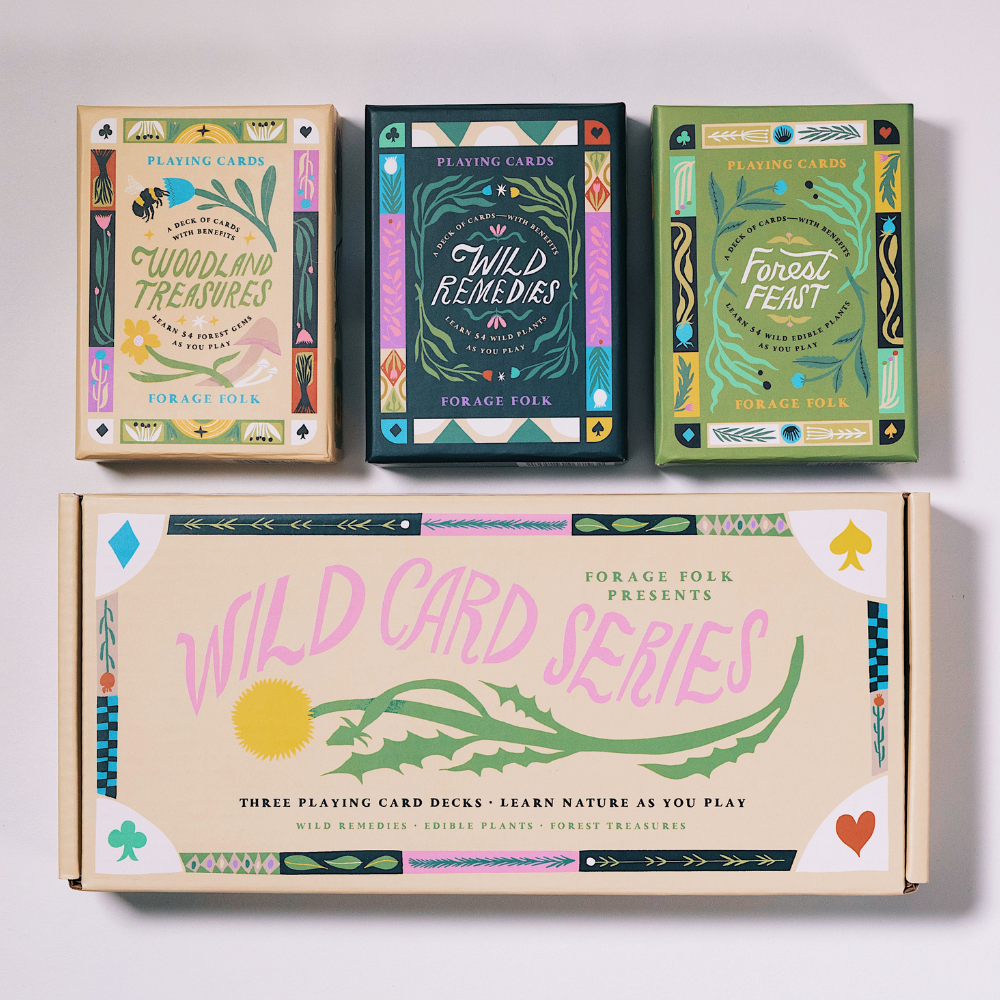
The Wild Card Series is a collection of three standard playing card decks — the familiar 54-card format, Ace through King, two Jokers — illustrated by Pacific Northwest artist Karli Fairbanks. Every single card in every suit features a different plant, herb, mushroom, tree, or forest subject, drawn in full botanical detail and annotated with its name and key information.
They play exactly like regular cards. Any game you already know works with these decks. You don't learn new rules. You don't turn game night into a nature lecture. You just play, and the knowledge accumulates — card by card, game by game, season by season.
Each deck includes a booklet of 20 classic card games, from quiet solo games to high-energy games for larger groups. The Trilogy Set — all three decks together — adds a printed version of that booklet, so everything you need is in one place.
Three decks. 162 illustrated plants, fungi, and forest subjects. Twenty classic card games. One gift-ready set for the person in your life who'd rather be outside than anywhere else.
The Decks
Wild Remedies: The Herbal Card Deck
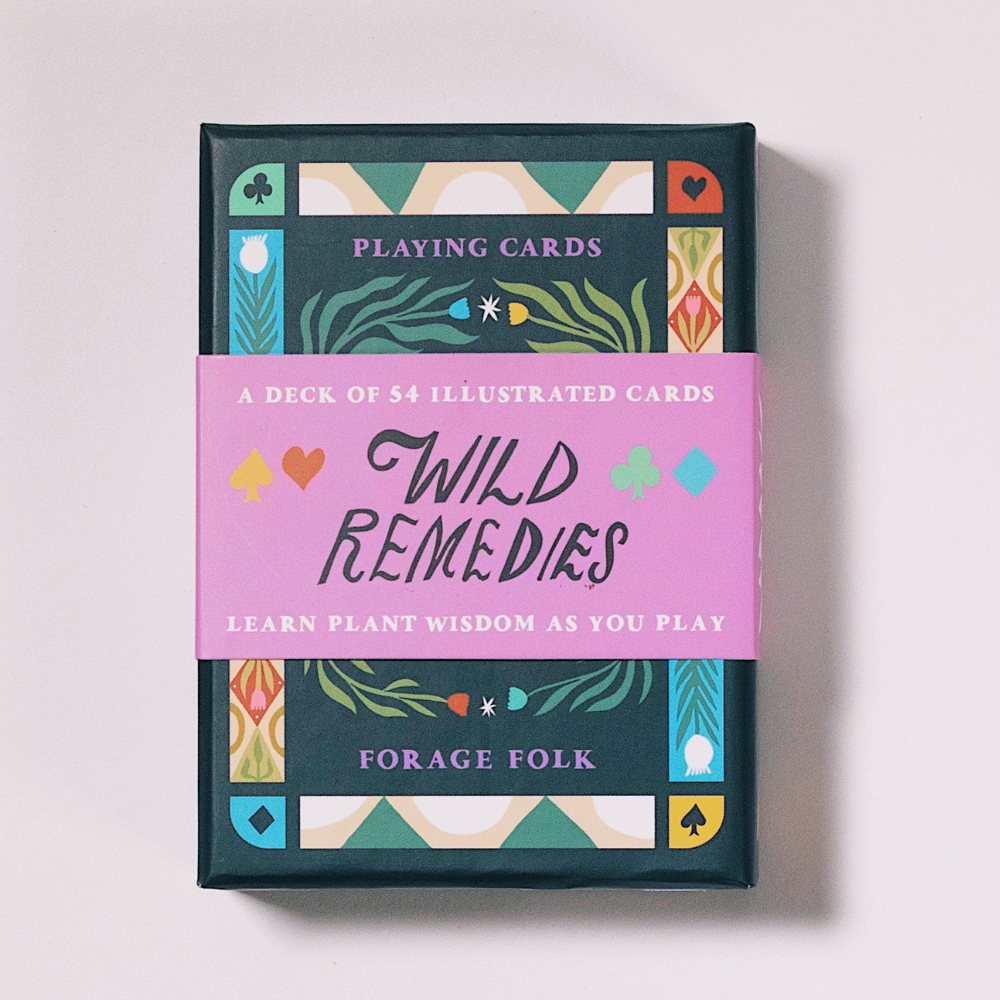
Fifty-four medicinal plants used in traditional herbal medicine for centuries. Elderberry for immunity. Yarrow for wound healing. Chamomile for sleep. Echinacea for colds. Calendula for skin. Nettle for nourishment. St. John's Wort for low seasons.
The cards are organized into four suits by how the plants work on the body — Detox & Cleansing, Skin & Topical Use, Nervines & Emotional, and Digestive & Circulatory. That framework is exactly how practising herbalists think about plants, and it turns out to be a remarkably effective way to absorb plant medicine — far more intuitive than the alphabetical lists most herbal books use.
Play it like a card game. Learn it like an herbalist. Wild Remedies is for anyone drawn to plant medicine, natural wellness, or the long human tradition of turning to the wild for healing. You don't need prior knowledge to start. You need a willing opponent and a spare evening.
Shop Wild Remedies → 54 illustrated playing cards · 20 classic games · $25
Forest Feast: The Edible Plants Deck
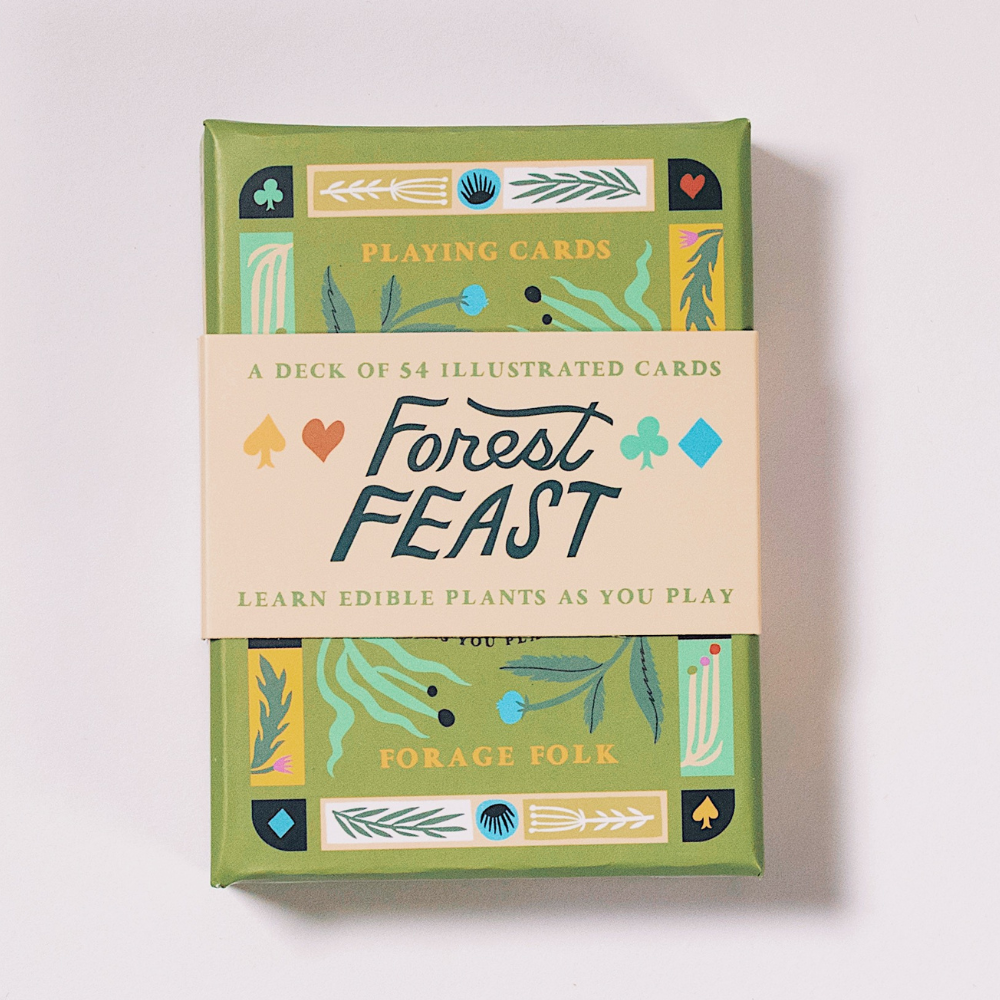
Fifty-four edible wild plants — the ones growing in the forests, fields, hedgerows, and verges that most of us walk past every day without realizing they're food. Dandelion. Chickweed. Wood sorrel. Hawthorn berry. Rose hip. Cleavers. Plantain. Elderflower. Wild garlic.
The suits organize plants by how the forest feeds us: Savory & Satisfying, Sips & Steeps, Sweet & Fruity, and Spice & Zest. It's a forager's pantry organized as a card game, and it reframes the way you look at any patch of ground.
Forest Feast is the most popular starting point in the series — approachable enough for complete beginners, interesting enough for experienced foragers who want to deepen their knowledge, and the most commonly gifted deck we stock. Take it on a cabin weekend. Pull it out at a dinner party. Leave it on the coffee table where the curious will pick it up. If you're new to foraging, our guide to the best wild edibles to forage in the Northwest pairs perfectly with this deck.
Shop Forest Feast → 54 illustrated playing cards · 20 classic games · $25
Woodland Treasures: The Forest Wonders Deck
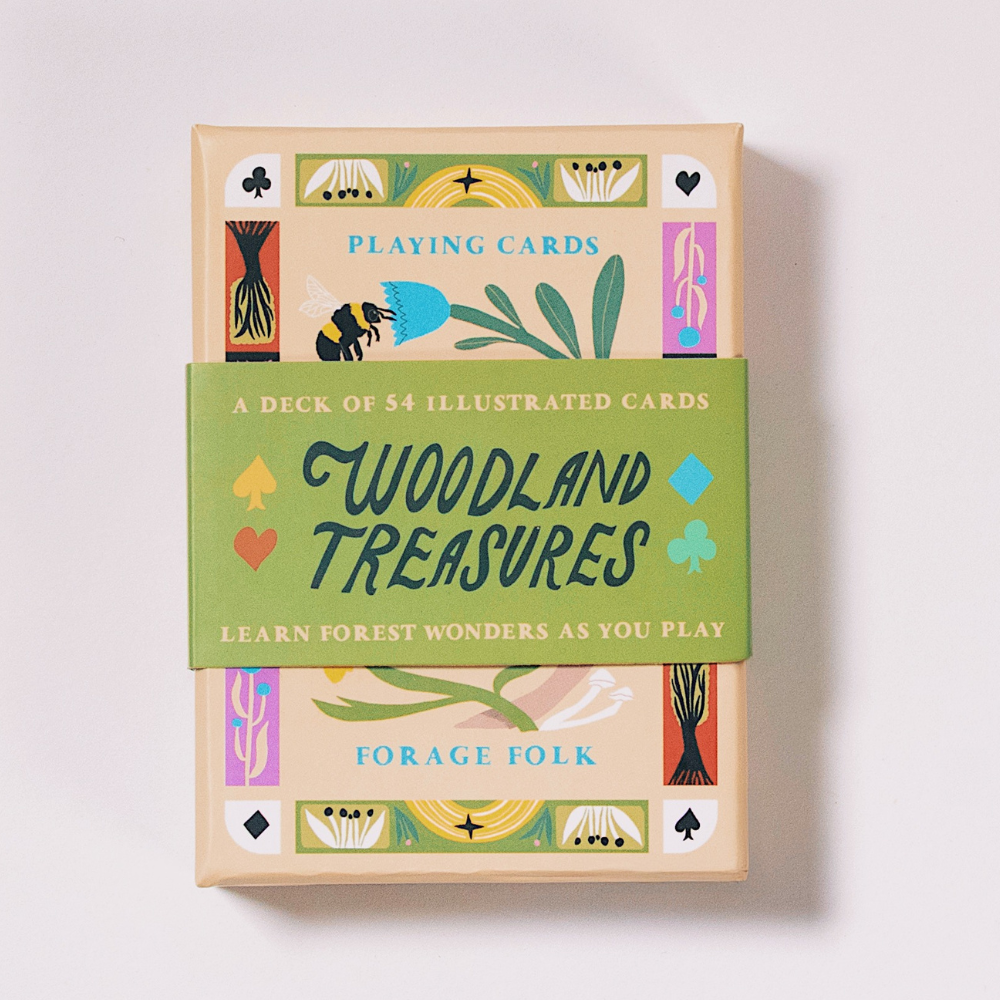
Fifty-four woodland subjects that take the Wild Card Series beyond the edible and medicinal — into the mycology, the ecology, the full living system of a forest. Trees. Mushrooms. Wildflowers. Insects. The subjects that make up a woodland's character and that most of us walk past without really seeing.
The suits cover Trees & Leaves, Mushrooms & Fungi, Wildflowers & Blooms, and Bugs & Tiny Things. Learn to distinguish a chanterelle from a false chanterelle. Understand why birch trees are the nurse trees of a forest. Discover what usnea lichen is doing on that branch.
Woodland Treasures is the wildlife card game that changes how you walk through a forest. Not because you've memorized a list — because you've played a hundred hands and the subjects have become familiar in the unhurried, reliable way that only repetition creates.
Shop Woodland Treasures → 54 illustrated playing cards · 20 classic games · $25
How to Play: Classic Games with a Wild Edge
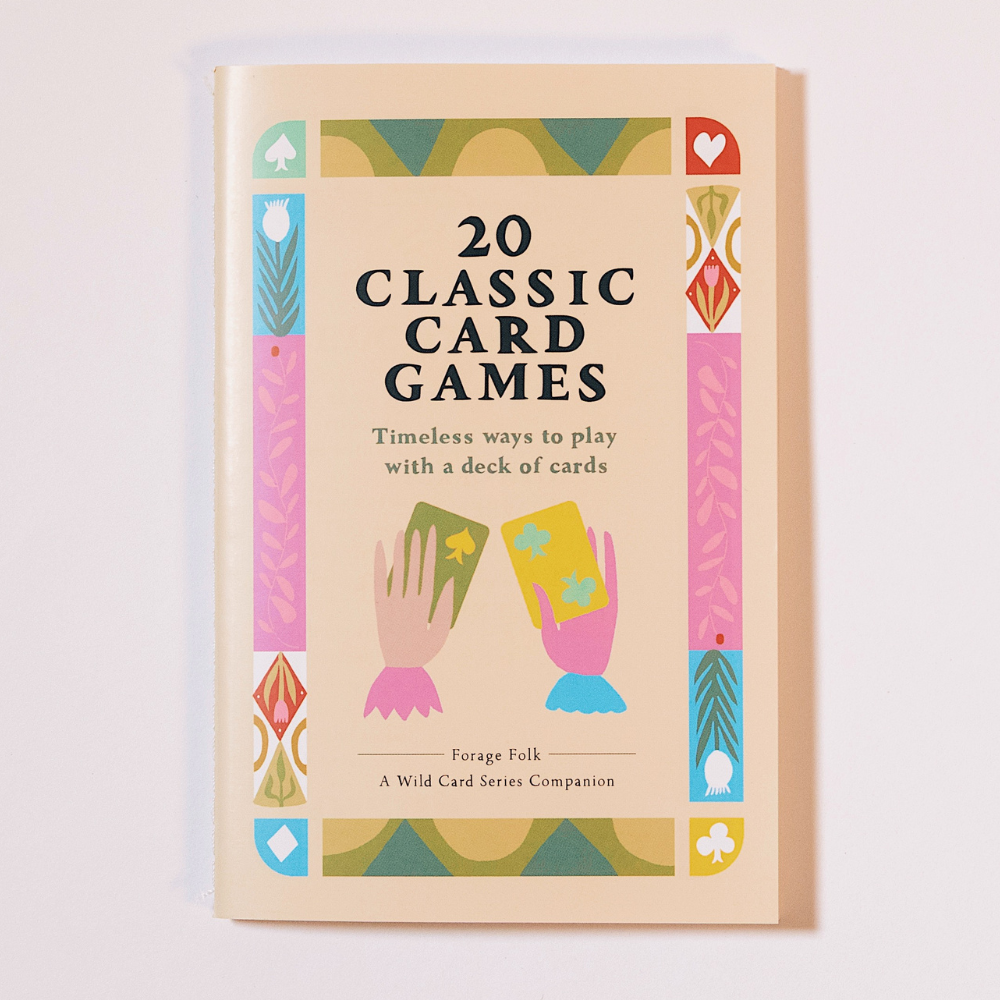
Every Wild Card Series deck includes a booklet of 20 classic card games. These are the games you already know, played with cards that quietly teach you something new every time you turn one over.
Gin Rummy is particularly well suited to the Wild Card Series. You pick up a card, you look at it, you consider whether it fits your hand, you put it down. Twenty minutes of that and you've encountered every plant in the deck at least once — more likely several times. The learning is incidental and therefore it sticks.
Snap rewards fast visual recognition — exactly the kind of pattern recognition that builds confident plant identification over time. The moment you automatically know the elder card before you've consciously read it is the same moment you'd know elderberry on a trail.
Go Fish introduces children to plant names through the most natural mechanism possible: asking and being answered. "Do you have any nettles?" "No — go fish." By the end of the game, everyone at the table knows what a nettle card looks like. Extend that to a summer of card games and they'll know what nettles look like in a hedgerow too.
Crazy Eights, War, Old Maid, Patience, Cribbage — all 20 games work exactly as you'd expect. The plants are on the cards. The rules are unchanged. The learning is in the hands.
Who Nature Card Games Are For
Herbalism beginners who want to learn medicinal plants without drowning in Latin or spending months with a textbook. The suit structure in Wild Remedies gives you a working framework for plant medicine without requiring you to study first.
Families with curious children who ask questions on walks that deserve better answers. These decks build a shared vocabulary for the natural world at the card table — long before anyone needs to identify anything in the field.
Hikers, campers, and foragers who want to deepen their relationship with the landscapes they move through. Knowing the name of a plant changes how you see it. Knowing its story — what it feeds, what it heals, what role it plays in the system around it — changes how you walk.
Nature educators and homeschool families looking for tools that don't announce themselves as tools. The Wild Card Series works as curriculum support, camp activity, or classroom enrichment without any of the self-consciousness of being labeled educational.
Gift-givers looking for something original and genuinely considered for the plant person, the forager, the herbalist, or the nature lover who already has everything but would treasure something made with this much care and intention.
Where to Buy the Wild Card Series
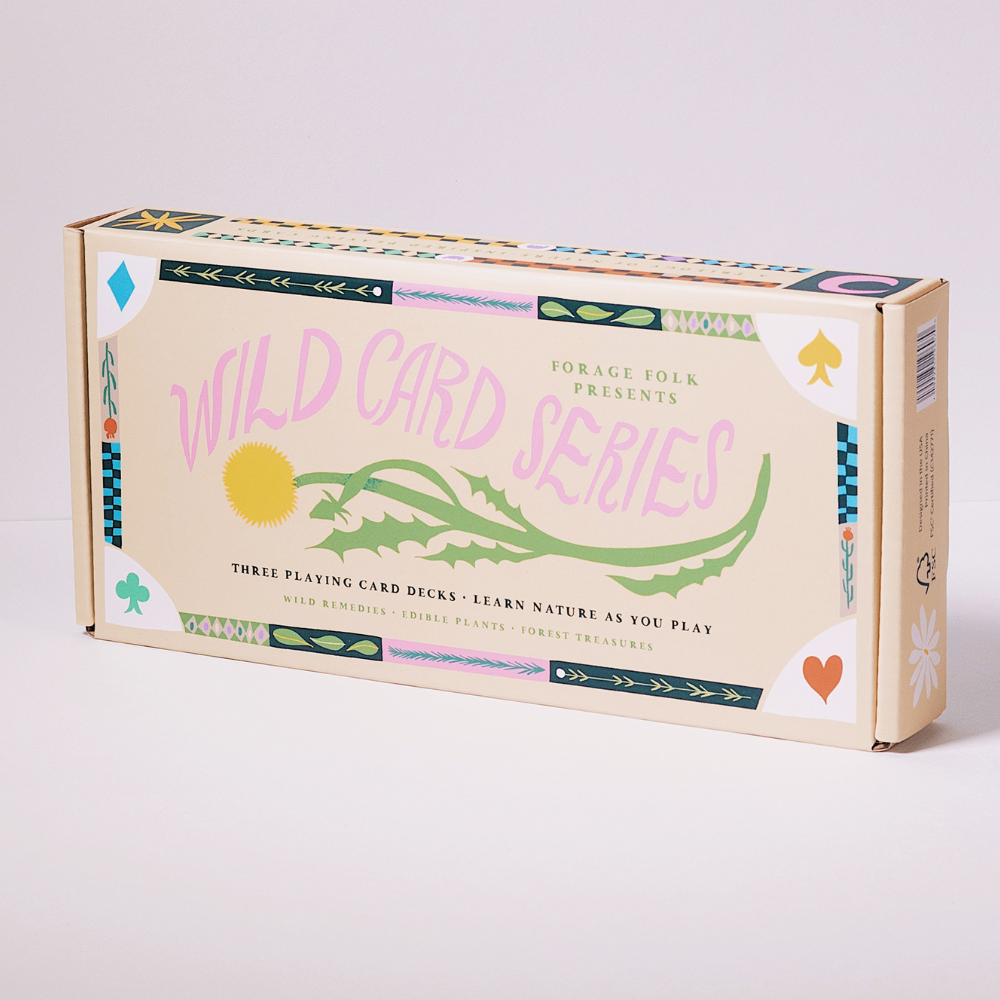
The Wild Card Series is available through the Forage Folk shop and on Amazon. Individual decks are $25 each. The Trilogy Set — all three decks plus the printed card games booklet — is $65, saving $10 versus buying separately.
Wild Remedies — 54 illustrated playing cards · 20 classic games · $25
Forest Feast — 54 illustrated playing cards · 20 classic games · $25
Woodland Treasures — 54 illustrated playing cards · 20 classic games · $25
The Trilogy Set — All 3 decks · 162 illustrated cards · printed games booklet · $65
If you're buying as a gift — or if you simply want the full picture — the Trilogy Set is the one to reach for. It covers every corner of the wild: remedies, feast, and wonder. One hundred and sixty-two illustrated subjects, twenty classic card games, and the kind of knowledge that builds quietly and lasts.
Frequently Asked Questions
Are the Wild Card Series cards actual playing cards or educational flashcards?
They are full standard playing card decks — 52 cards plus 2 Jokers, the exact same format as any deck you'd buy in a store. Every card has a plant or forest subject illustrated on its face, but the deck plays exactly like a regular deck of cards. Any card game you already know works with these — Rummy, Go Fish, Snap, Cribbage, Patience, and 16 more in the included booklet.
What age are nature card games suitable for?
The Wild Card Series is designed primarily for adults and families with children aged 8 and up. Simpler games in the booklet — Snap, Go Fish, War — work well with younger children as a gentle introduction to plant names. The illustrated cards are engaging for curious kids even when they're not actively playing, and many families keep them on the coffee table as a talking point.
Which Wild Card Series deck should I start with?
Forest Feast (edible wild plants) is the most popular starting point — the plants are accessible, recognisable, and immediately useful on walks. Wild Remedies is the favourite among anyone drawn to herbalism and natural wellness. Woodland Treasures suits the forest-obsessed: mushroom hunters, tree lovers, people who want to understand the whole living system of a wood. If you're unsure, the Trilogy Set is the best value and covers all three worlds.
Can I use these cards for foraging identification in the field?
The cards are educational primers, not field guides — they build familiarity and curiosity rather than replace proper identification resources. We always recommend cross-referencing with a quality regional field guide before consuming any wild plant. That said, many experienced foragers use the cards as companions to their field guides, finding that the illustrations and concise facts are excellent for reinforcing what they've already learned.
Do the Wild Card Series decks work with standard card game rules?
Yes — completely. The suits and values follow the standard 52-card structure (plus 2 Jokers), so any game that uses a regular deck works with these. The included 20 Classic Card Games booklet covers the most popular games with clear instructions, from quick two-player games to larger group games. No special rules, no nature-specific mechanics — just regular card games played with cards that happen to teach you the wild.
Printed on FSC-certified paper. Eco-conscious matte laminate finish. Illustrated by Karli Fairbanks, Pacific Northwest artist. Designed for learning and play — not for plant identification in the field.
Forage Folk curates timeless goods rooted in nature. We are foragers first, hunting for soulful creations that fuse nature's bounty with the artistry of gifted hands.
See what else the forest has to offer: EXPLORE THE TREEHOUSE SHOP


